

loading...
Embodied AI is shifting the focus from model capabilities to real-world execution capabilities.
Large Language Models (LLMs) and reinforcement learning have substantially enhanced robots' capabilities in environmental understanding, task planning, and autonomous decision-making. However, once AI capabilities are deployed in robot bodies, a range of underlying challenges must still be addressed: trajectory accuracy during high-speed motion, dynamic response in complex environments, compliance when robots contact objects, and safety control under external disturbances and abnormal conditions.
Huayan Robotics' next-generation HRC is designed precisely for this capability layer.
As Huayan Robotics' robotic "cerebellum" platform for Embodied AI, HRC connects upward to AI capabilities such as LLMs and reinforcement learning, and downward to robot bodies, joints, drives, vision, force sensing, and tactile sensing systems, establishing a real-time control layer between AI and physical execution.
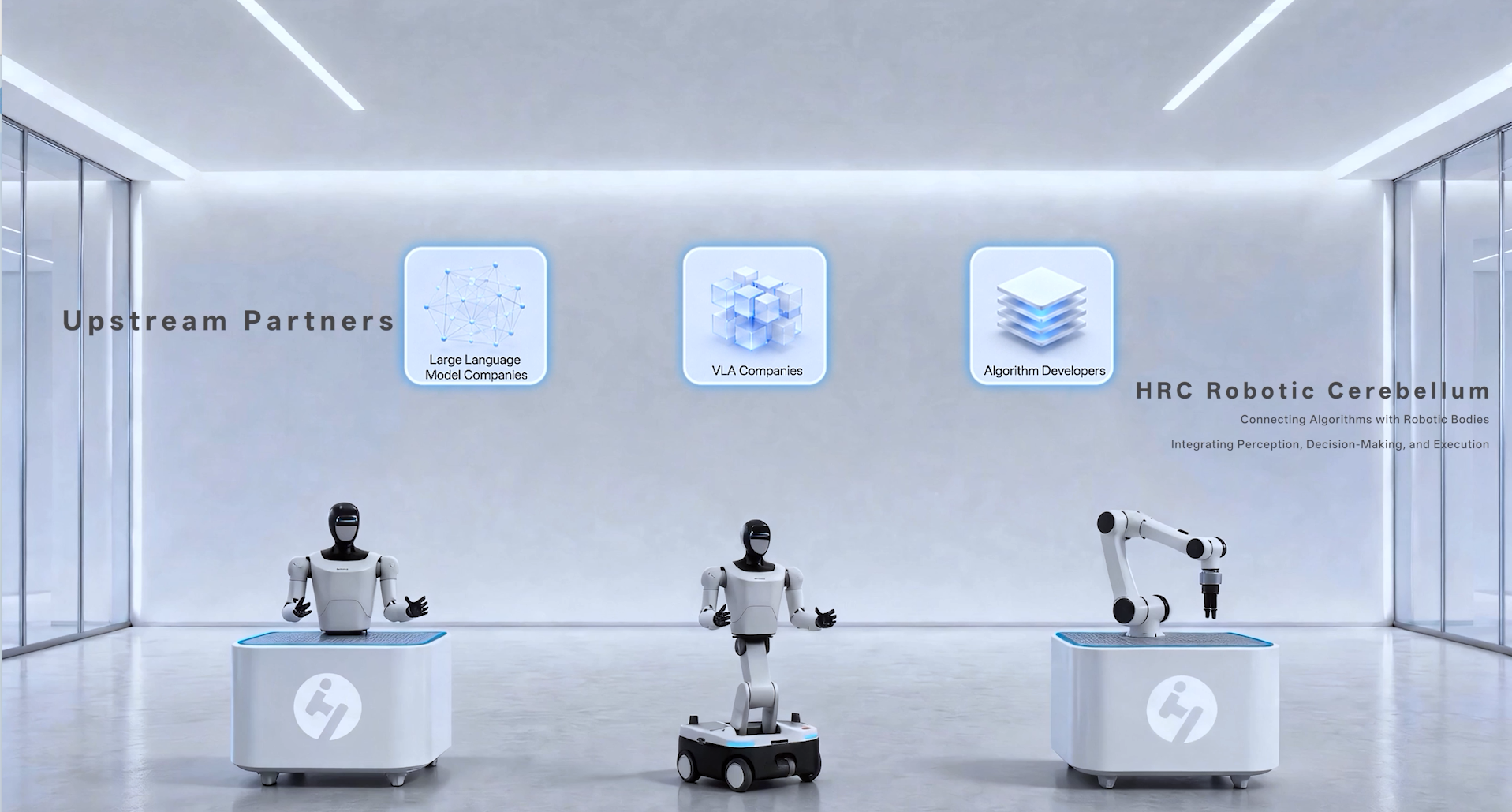
From Perception to Execution: Building a Closed-Loop Real-Time Control System
Huayan Robotics' next-generation HRC integrates core modules including motion control, multimodal perception, safety response, and precise dynamic interaction into a real-time control system that spans perception, decision-making, and execution.
The platform employs a 2 kHz real-time control cycle and a high-speed EtherCAT bus to continuously process feedback from joints, vision, force sensing, and tactile sensing. It dynamically compensates for trajectory deviations, contact states, and external disturbances, meeting the real-time performance and stability requirements of high-speed, high-precision industrial operations.
Beyond conventional position control, HRC further enhances the robot's dynamic interaction capabilities with its environment.
By establishing a dynamic relationship between motion and external forces, impedance control enables the robot to adjust its motion response based on the contact state. Compliant force control further improves the robot's adaptability to its environment in tasks such as assembly, insertion, polishing, and grasping.
Robots thereby advance beyond simple trajectory execution toward integrated control of position, force, and environmental interaction.
20+ Years of Core Motion Control Technology, 10 Years of Collaborative Robot Experience
HRC's technical foundation predates the rise of Embodied AI.
Huayan Robotics began with motor technology 20 years ago and entered the collaborative robot field 10 years ago.
Through long-term R&D in motors, drives, and motion control, as well as the continued application of collaborative robots in real industrial scenarios, Huayan Robotics has accumulated extensive engineering experience directly connected to the physical world.
Trajectory errors during high-speed motion, dynamic responses under varying loads, mechanical vibration, friction and backlash, force variations during contact, and recovery and safety boundaries following external disturbances to robots have been recurring challenges throughout Huayan Robotics' evolution from motor technology to robot products.
Motion control, force control, compliance, impedance control, vibration suppression, and safety capabilities have thus formed a continuously evolving technology foundation.
AI can rapidly advance model capabilities, whereas a robot's underlying control capabilities require long-term accumulation in hardware, algorithms, and industrial scenarios.
Huayan Robotics' HRC embodies the physical-world know-how built on 20 years of motor technology and 10 years of experience in collaborative robotics, and further transforms it into a scalable platform.
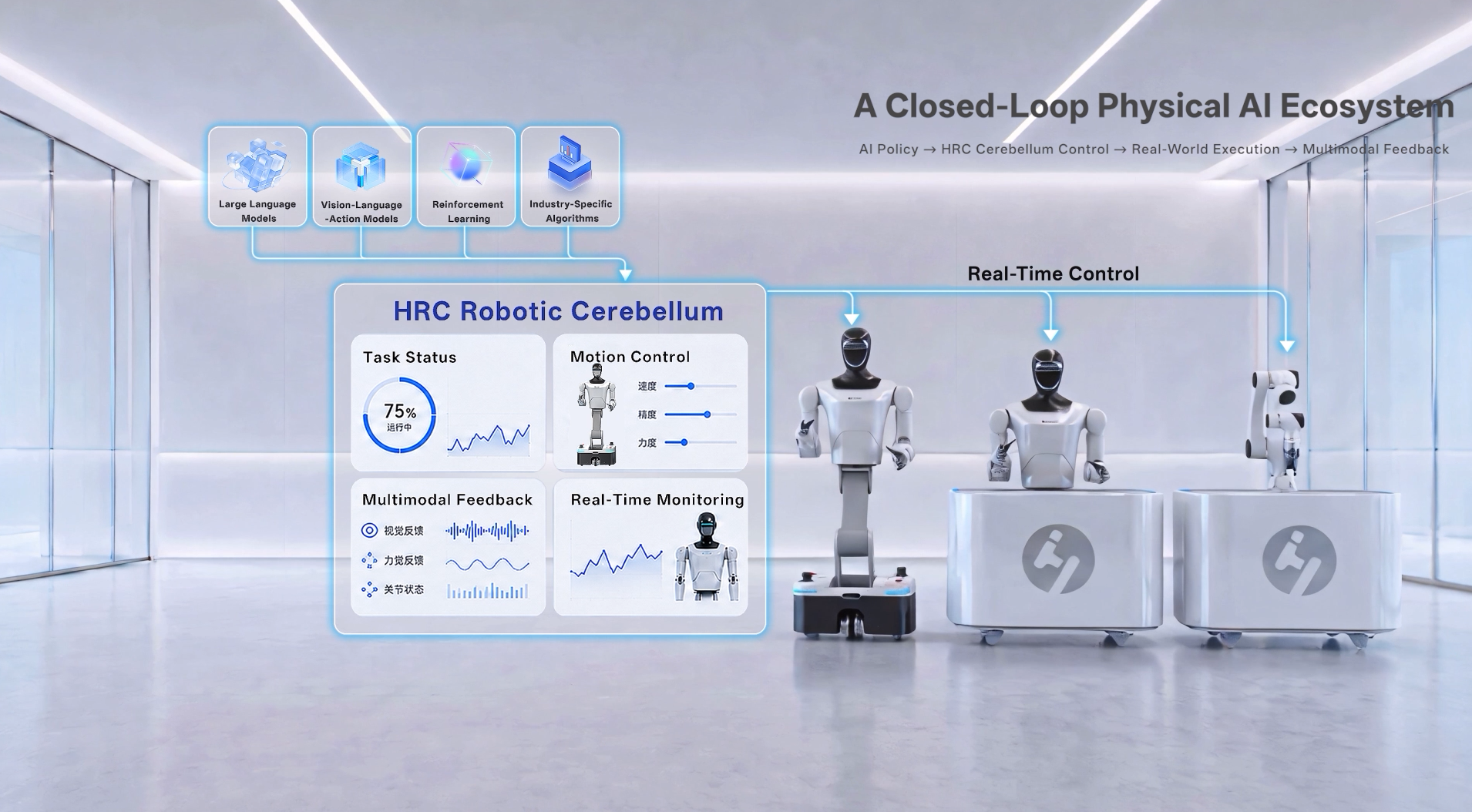
Open Connectivity to AI: Making Control Capabilities Reusable Infrastructure
The development of Embodied AI is giving rise to a diversified model ecosystem. LLMs, reinforcement learning, and enterprise-developed algorithms can all serve as a robot's "brain."
Huayan Robotics' HRC is not tied to a specific upper-layer AI architecture. Instead, through open interfaces, it connects diverse AI capabilities to the robot's underlying control system.
The upper-layer model is responsible for task understanding, environmental assessment, and policy generation; HRC is responsible for converting policies into real-time motion, force control, and safe execution.
This architecture decouples AI capabilities from the robot's underlying control capabilities, while making underlying capabilities such as motion planning, trajectory control, impedance control, and compliant force control more reusable.
Complex tasks can be planned by AI and then executed by invoking HRC's underlying control capabilities.
While models continue to iterate, the control base remains stable; as AI capabilities evolve, robot execution capabilities can be continuously reused.
An AI Execution Layer for the Real World
For Embodied AI, model training is only one part of the complete pipeline. Algorithms must ultimately be deployed on physical robots and continuously receive feedback through vision, force sensing, joint states, and motion outcomes in real-world environments.
Huayan Robotics' next-generation HRC provides the real-time execution foundation for this process:
AI model → HRC → physical robots → multimodal feedback → reinforcement learning → policy optimization
Through a real-time closed loop between AI and the robot control system, reinforcement learning policies can be validated in real-world environments, while data generated in the physical world can further support algorithm optimization.
This enables HRC not only to perform underlying robot control functions, but also to serve as a critical execution layer that brings AI capabilities from models into the physical world.
Providing Different "Brains" with the Same Reliable "Cerebellum"
In the future, higher-level intelligence in robotic systems will become increasingly diverse, while underlying execution capabilities must remain stable, open, and reusable. For the era of Embodied AI, Huayan Robotics is committed to providing universal underlying software and hardware capabilities that empower diverse industries and application scenarios.
HRC integrates core modules. Built on real-time control and backed by Huayan Robotics' 20 years of motor technology, 10 years of collaborative robotics practice, and long-term experience in industrial scenarios, it connects upward to continuously evolving AI capabilities and downward to physical robots and the physical world.
HRC enables different "brains" to share the same reliable "cerebellum."
Making AI easier to deploy in robots and enabling robots to execute AI-driven tasks more reliably.

